How AI Receptionists Help Austin Veterinary Clinics Win After-Hours Pet Emergency Calls
Austin sits on top of one of the most pet-obsessed markets in the United States. Here is how AI voice agents are helping local veterinary clinics answer every after-hours emergency call, triage them cleanly, and stop losing cases to the 24/7 ER across town.
Quick summary
- How a veterinary clinic in Austin can use an AI receptionist to capture after-hours emergency calls and reduce front-desk burnout.
- Austin Is the Most Pet-Obsessed Market in America — and Phones Cannot Keep Up
- After-Hours Does Not Mean What It Used To
- The Cost Is Not Just Lost Revenue — It Is a Burned-Out Front Desk
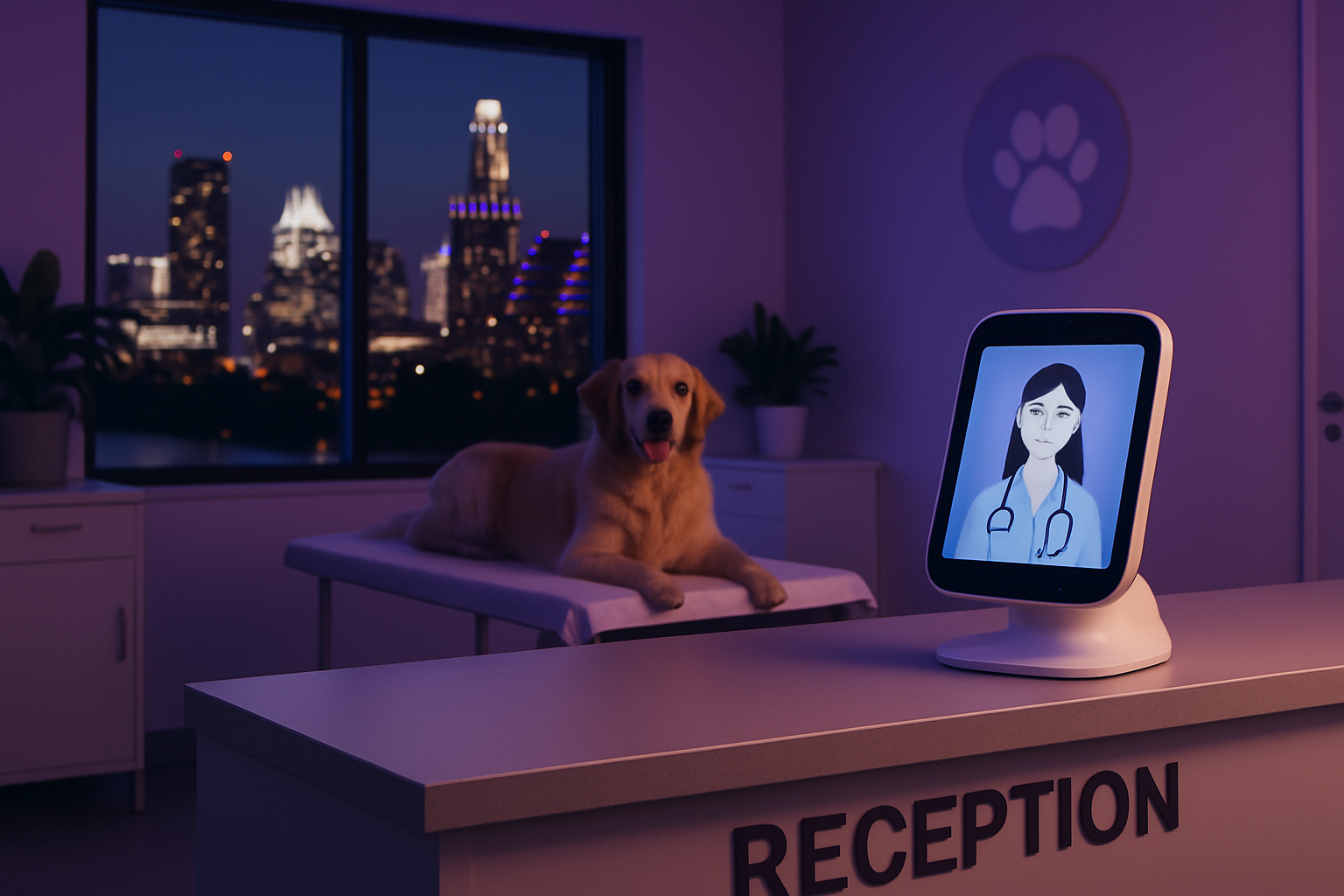
It is 11:47 p.m. on a Tuesday in South Austin. A golden retriever named Biscuit has just thrown up something he should not have, and his owner is dialing every vet within a five-mile radius. The first clinic that picks up gets the visit, the trust, and probably the long-term client. Everyone else gets nothing — not even a voicemail.
That dynamic plays out every night in Austin, and it is quietly reshaping which veterinary practices grow and which stagnate. Pet owners are spending more, expecting faster service, and showing zero patience for ringing phones. For Austin clinics — operating in one of the fastest-growing pet markets in the country — the after-hours phone has become a make-or-break channel.
This guide breaks down why so many Austin vet practices are losing emergency calls they do not even know about, what an AI receptionist actually does for a clinic, and how to think about ROI when you are already drowning in daytime calls. LucroVox built its voice agent for exactly this kind of work.
Austin Is the Most Pet-Obsessed Market in America — and Phones Cannot Keep Up
Austin punches well above its weight in pet care. The metro area has roughly 950,000 households with a 75% pet ownership rate, supporting an estimated 1.3 million pets and an annual pet spend that crosses $2.8 billion. Austin households average $2,100 a year on their pets, well above the $1,480 national average, with veterinary care accounting for roughly 28% of that wallet. The market is also growing 6 to 8% annually, faster than the U.S. as a whole. (Wagbar Austin pet market analysis)
That is the upside. The downside is that demand is outpacing how front desks are staffed. Industry data shows the average veterinary clinic misses 20 to 30% of inbound calls during business hours, and most animal hospitals miss 30 to 70% of after-hours emergency calls when they route to voicemail or to an unmanned line. (Puppilot phone-bottleneck data)
Translate that into Austin numbers. A mid-size practice taking 80 calls a day with another 15 to 25 after-hours calls per week is realistically losing 5 to 8 emergency conversations every week — calls that go straight to a competitor, a 24/7 emergency hospital across town, or worse, to nobody.
After-Hours Does Not Mean What It Used To
Pet owners no longer treat 6 p.m. as the end of the day. Industry research consistently shows that more than a third of after-hours veterinary calls are genuine emergencies, and pet owners expect a callback inside 15 minutes when they leave one. The problem: most will not bother. Across veterinary call-tracking studies, around 72% of callers who reach an after-hours voicemail simply hang up, and roughly 85% of missed callers never try a second time. (Skipcalls after-hours caller data)
In emergency veterinary marketing this is sometimes called the first call wins rule — and the conversion data backs it up. One emergency-focused vet practice running an "open now" campaign reported a 52% phone conversion rate, meaning more than half of the people who tapped to call became patients that night. (TailWerks emergency vet PPC analysis)
For an Austin clinic, the implication is hard to dodge: if your phone rings out after 7 p.m., the case is gone the moment a competitor's phone connects. The owner is not going to call back tomorrow. They are going to drive to whoever answers.
The Cost Is Not Just Lost Revenue — It Is a Burned-Out Front Desk
The other half of this story is what the phone is doing to your team. Veterinary medicine is in a documented well-being crisis. According to AVMA-cited surveys, 72% of veterinary professionals report exhaustion compared to 32% of the general U.S. workforce, and roughly 80% of hospital managers and CSRs report low to medium burnout. The 2025 AVMA Economic Report found that nearly half of veterinarians experience mental health issues directly tied to their work. (CO.vet burnout statistics)
The front desk is the funnel everything pours through. CSRs at a busy Austin practice often juggle a patient checking out, a tech needing a chart, and three lines ringing simultaneously. Something has to drop. Usually it is the third caller — who happens to be the new client you spent $30 in Google Ads to acquire.
This is the second case for AI receptionists, and it is the one that matters most for retention: your team stops triaging the phone and goes back to triaging patients.
What an AI Receptionist Actually Does for a Vet Clinic
An AI voice agent is not a phone tree or a robotic "press 1 for appointments." It answers in under a second, holds a natural conversation, and follows your clinic's specific protocols. For veterinary use, a well-configured agent typically handles four jobs.
The first is emergency triage. The agent asks structured questions — species, age, what the pet ingested or is doing, how long it has been going on — and decides whether to route the caller to an on-call vet, to your partnered ER (for many Austin clinics that means Central Texas Veterinary Specialty Hospital or BluePearl), or to schedule a next-morning visit. The triage logic is yours; the AI just executes it consistently at 2 a.m. the same way it does at 2 p.m.
The second job is appointment booking. The agent reads your practice management system or a connected scheduling tool, offers genuinely available slots, confirms with the owner, and books the visit. No staff involvement required.
The third is prescription refills, food orders, and routine FAQ — vaccines, boarding policies, payment options, directions. These calls account for a huge share of daytime volume and are exactly the kind of work that grinds CSRs down.
The fourth is the lead capture you are missing today. When a new pet owner calls at 9 p.m. asking if you are taking new patients, the AI welcomes them, collects their info, schedules an intake, and texts them a confirmation. The relationship starts before your team even knows it exists.
What a Good AI Call Sounds Like
The fastest way to understand the value is to read a realistic transcript. Here is roughly what an Austin emergency call looks like with a well-trained AI agent at 11:30 p.m.
AI: Thanks for calling Lamar Veterinary. This is Riley, the after-hours line. Is this an emergency, or is this something we can schedule for the morning?
Caller: My dog ate a chocolate bar like an hour ago.
AI: I am sorry — that is stressful. Can you tell me your dog's breed and weight, and roughly how much chocolate and what kind?
Caller: He is a 30-pound border collie mix. It was a Hershey's bar, dark chocolate, looked like maybe four ounces.
AI: Got it. Based on weight and the amount of dark chocolate, this needs same-night care. Our on-call vet is Dr. Patel — I can either page her now or, if you are closer to Mopac, route you to Central Texas Veterinary Specialty Hospital which is open 24/7. Which works better?
That conversation, handled in under 90 seconds, is the difference between a saved patient and a Google review that mentions "I called three times and nobody picked up."
Setting It Up: A Realistic Path for an Austin Clinic
Most clinics roll out AI in four phases. Phase one is forwarding only after-hours and overflow calls — anything that would otherwise hit voicemail. This is the lowest-risk way to test the system and typically recovers the largest pool of missed revenue first. (LucroVox after-hours guide)
Phase two is daytime overflow during peak hours — usually 8 to 10 a.m. and the post-lunch rush — when your CSRs are saturated.
Phase three is full triage logic, with the AI deciding emergencies vs. routine, integrated with your PIMS for live availability. (LucroVox emergency-call-handling guide)
Phase four is proactive outbound: vaccine reminders, post-visit check-ins, prescription refill confirmations. This is where the ROI compounds, because you are not just answering calls — you are filling next week's schedule.
A typical Austin clinic with 80 calls a day and 25 after-hours calls a week recovers its monthly AI cost in the first week of operation, usually on a single saved emergency case. (LucroVox ROI framework)
The Math, Sketched Out
Say an Austin practice loses 6 after-hours emergency cases per week to unanswered calls, and the average emergency case is worth $350 in same-night revenue plus an estimated $900 in lifetime value from a new long-term client. That is roughly $2,100 in immediate revenue and $5,400 in lifetime value walking out the door every week — not counting reputational damage from Google reviews.
Even recovering a third of that — two cases a week — pays for an AI receptionist many times over and frees your CSRs to do the work they were actually hired for. (LucroVox missed-calls cost analysis)
The Bottom Line for Austin Vets
Austin's pet market is one of the most lucrative in the country, but the phone has become the bottleneck. Every clinic in the city is fighting for the same after-hours emergency calls — and the practice that answers in one second beats the practice that answers in three rings.
If you are already losing cases to voicemail or to the 24/7 ER across town, an AI receptionist is the cheapest, fastest way to plug the leak. Your CSRs get their day back. Your on-call vet gets clean, triaged hand-offs instead of midnight cold calls. And the next time Biscuit eats something he should not, your phone is the one that picks up. See LucroVox plans below for pricing and a hear-it-live demo.
Useful LucroVox links
FAQ
Will pet owners realize they are talking to AI?
Most modern voice agents sound conversational enough that callers do not notice in the first 30 seconds. Best practice for veterinary use is to be transparent — introduce the AI as the after-hours line and make it clear a human is paged for emergencies. Owners care about getting their pet help fast; they do not care who picks up.
Can it integrate with my practice management system?
Yes, for most major PIMS platforms — including direct calendar reads, appointment writes, and basic patient record lookups. The depth of integration depends on your software vendor API, but at minimum the agent can read availability and book appointments.
What about data protection for pet medical info?
Pet health information is not covered by HIPAA, but client information is still subject to general data protection rules. A reputable AI receptionist provider should offer encryption in transit and at rest, configurable data retention, and a signed data processing agreement if your jurisdiction requires it.
How long does setup take for an Austin clinic?
Most practices are live on after-hours-only routing within 5 to 7 business days, with full daytime integration taking another two to three weeks depending on how custom the triage logic gets.
Ready to stop losing calls?
See how LucroVox can answer, qualify, and document the calls your team cannot catch live.
See LucroVox plans